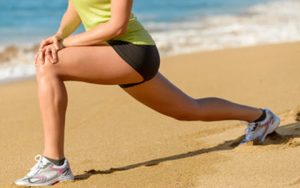
The 3 Best Stretches for Lacrosse
Improve your lacrosse and minimize injuries with 3 of the best lacrosse stretches.
by Brad Walker | Updated October 14, 2024
The physically demanding sport of Lacrosse was first played by Native Indian tribesmen in North America. To score, you have to shoot a small rubber ball into the opposing team’s goal using a long handled racket.
Lacrosse was also called baggataway, tewaarathon and deconchigwiis. It has deep spiritual roots in native culture and was thought of as The Creator’s Game. It was believed to impart important lessons in courage, honor, respect, and strength, and was often played to settle disputes between rival tribes as well as to train warriors for battle.
The game was named Lacrosse by the French missionary Jean de Brébeuf in the 1600’s. William George Beers formed the Montreal Lacrosse Club and the modern rules in 1867.

Muscles used in Lacrosse
The primary muscles used by lacrosse players are the quadriceps and hamstrings (front and back of thigh), trapezius and rhomboids (neck, shoulder and back), calves (lower legs), biceps, triceps, flexor carpi radialis and flexor carpi ulinaris (upper and lower arm). There are several other muscles used to assist this primary group and these include the chest, hip flexors, obliques and abdominals.
The motion of throwing the ball involves the utilization of the core muscles in the torso. The rectus abdominis and obliques in the abdominal region together with the latissimus dorsi in the lower back play an important role in the quality of an athlete’s game. They assist the player in maintaining a good defensive body position and offer support when twisting the body toward the cage while shooting.
Most Common Lacrosse Injuries
The most common non-contact related injuries suffered by lacrosse players are chronic (overuse) injuries, and include:
- Rotator cuff tendinitis; and
- Running related injuries, including Iliotibial band (ITB) syndrome, shin splints, and hamstring tendinitis.
Common acute (traumatic) injuries suffered during lacrosse include:
- Bruises and contusions;
- Concussion;
- Wrist, hand, and thumb strain and fracture;
- Rotator cuff strain;
- Knee injuries, including anterior cruciate ligament (ACL) sprain, medial collateral ligament (MCL) sprain, and meniscus tear;
- Muscle strain, including hip flexor strain, groin strain, and hamstring strain; and
- Ankle sprain.

Injury Prevention Strategies
To help reduce the potential for sports related injuries it is important to condition the body through regular training and exercise. The following are useful in helping to prevent injury:
- It is also crucial to have a regular warm-up routine that prepares the body for both training and games.
- Allow time after training and competition for a complete cool-down, including stretching.
- A thorough strength training program will help to build resistance to injury.
- Improved cardiovascular fitness will help to prevent fatigue in the later stages of training and games.
- A comprehensive flexibility training program will reduce injuries from tight and inflexible muscles.
- Practice balance, agility, and proprioception drills to improve knee and ankle stability.
- Proper fitting and supportive footwear will help prevent many overuse injuries.
- Use ankle supports (braces, taping, strapping, etc.) to help reduce the incidence of ankle sprains.
- A mouth guard helps protect the teeth and mouth.
- Using high quality protective equipment that has been maintained properly will help prevent many injuries.
The 3 Best Stretches for Lacrosse
Lacrosse stretches are one of the most under-utilized techniques for improving athletic performance, preventing sports injury and properly rehabilitating sprain and strain injury. Don’t make the mistake of thinking that something as simple as stretching won’t be effective.
As with any sport or activity there are rules and guidelines to ensure that they are safe. Stretching is no exception. Stretching can be harmful and cause injury if done incorrectly. It is vitally important that the following stretching guidelines be adhered to, both for safety and for maximizing the benefits of the stretches below.
Below are 3 of the best stretches for lacrosse; obviously there are a lot more, but these are a great place to start. Please make special note of the instructions with each stretch, and if you currently have any chronic or recurring muscle or joint pain please take extra care when performing the stretches below, or consult with your physician or physical therapist before performing any of the following stretches.
Instructions: Slowly move into the stretch position until you feel a tension of about 7 out of 10. If you feel pain or discomfort you’ve pushed the stretch too far; back out of the stretch immediately. Hold the stretch position for 20 to 30 seconds while relaxing and breathing deeply. Come out of the stretch carefully and perform the stretch on the opposite side if necessary. Repeat 2 or 3 times.


Research and References
- Walker, B. (2011). The Anatomy of Stretching, 2nd Edition (ISBN: 978-1583943717)
- Wikipedia contributors. (2019, April 23). Lacrosse, In Wikipedia, The Free Encyclopedia.
- Kerr, K. Quigley, A. Yeargin, S. Lincoln, A. Mensch, J. Caswell, S. Dompier, T. (2017). The epidemiology of NCAA men’s lacrosse injuries, 2009/10-2014/15 academic years. Injury Epidemiology, 4:6.
- Barber Foss, K. Le Cara, E. McCambridge, T. Hinton, R. Kushner, A. Myer, G. (2017). Epidemiology of injuries in men’s lacrosse: injury prevention implications for competition level, type of play, and player position. The Physician and Sportsmedicine, 45(3), 224-233.
- Vincent, H. Vincent, K. (2018). Core and Back Rehabilitation for High-speed Rotation Sports: Highlight on Lacrosse. Current Sports Medicine Reports, 17(6), 208-214.
- Kokkonen, J. Nelson, A. Eldredge, C. Winchester, J. (2007) Chronic Static Stretching Improves Exercise Performance. Medicine & Science in Sports & Exercise, 39(10), 1825-1831.
- Shellock, F, Prentice, W. (1985) Warming-up and stretching for improved physical performance and prevention of sports-related injuries. Sports Medicine, 2(4):267-78.
- Fradkin, A. Zazryn, T. Smoliga, J. (2010) Effects of warming-up on physical performance: a systematic review with meta-analysis. Journal of Strength and Conditioning Research, 24(1):140-8.
 About the Author: Brad Walker is often referred to as the "Stretch Coach" and has even been called the Stretching Guru. Magazines such as Runners World, Bicycling, Triathlete, Swimming & Fitness, and Triathlon Sports have all featured his work. Amazon (author page) has listed his books on five Best-Seller lists. Google cites over 100,000 references to him and his work on the internet. And satisfied customers from 122 countries have sent 1,000's of verified customer reviews. If you want to know about stretching, flexibility or sports injury management, Brad Walker is the go-to-guy.
Disclaimer: The health and fitness information presented on this website is intended as an educational resource and is not intended as a substitute for proper medical advice. Please consult your physician or physical therapist before performing any of the exercises described on this website, particularly if you are pregnant, elderly or have any chronic or recurring muscle or joint pain.