
The 3 Best Stretches for Squash
Improve your squash and minimize injuries with 3 of the best squash stretches.
by Brad Walker | Updated September 16, 2024
Squash requires a good deal of agility and good reaction to move to the ball. Upper body strength is required to swing the racket and provide a solid hit. Overall conditioning is also important to be able to play a complete game.
Flexibility is vitally important due to the various contorted positions a player may need to move through to react to the ball. Incorporating stretches for squash in your training program will improve your performance and help to minimize the risk of injury.

Muscles used in Squash
The major muscles used when playing squash include:
- The muscles of the shoulder girdle; the pectorals, and the deltoids.
- The muscles of the upper legs and hips; the gluteals, the hamstrings, and the quadriceps
- The muscles of the forearm and upper arm; the wrist flexors and extensors, the biceps, and the triceps.
- The core muscles; the rectus abdominus, obliques, and the spinal erectors.
A good overall training program that focuses on flexibility, agility, endurance and cardiovascular conditioning will help the squash player stay healthy and rebound from injuries quickly.
Most Common Squash Injuries
Squash can lead to traumatic injuries when players quickly change direction to react to a ball or when they fall, striking the hard court surface. Chronic injuries can result from the repetitive swinging motion.
As with most racket sports; injuries to the shoulder and upper extremities are common. The common injuries experienced by a squash player include:
- Muscle and tendon strains;
- Separated shoulder and AC joint injury;
- Rotator cuff tendinitis and tears;
- Tennis elbow (lateral epicondylitis);
- Lower back pain;
- Anterior cruciate ligament (ACL) sprain;
- Meniscus tear; and
- Ankle sprains.

Injury Prevention Strategies
Proper training, adequate rest between training or competitions, and good nutrition are all essential for peak performance in squash. The following tips can also help avoid injury:
- Always warm-up thoroughly prior to training and especially competition.
- Allow adequate time for a complete cool-down after training and competition.
- Strength training for the muscles of the shoulder girdle will protect the shoulder joint. A solid overall strengthening program will protect all of the joints and prevent muscle strains and tendon issues.
- A good cardiovascular conditioning program will help prevent the early onset of fatigue that can lead to injury.
- Stretching, as a regular regimen and after intense play, will keep the muscles flexible and ready to perform at their peak when called into action. Good flexibility reduces the incidence of many sports injuries.
- Using proper equipment and courts designed for the game will also prevent many acute and chronic injuries. Proper racquet selection and grip size are critical in preventing tennis elbow and other injuries related to improper technique.
The 3 Best Stretches for Squash
Squash stretches are one of the most under-utilized techniques for improving athletic performance, preventing sports injury and properly rehabilitating sprain and strain injury. Don’t make the mistake of thinking that something as simple as stretching won’t be effective.
As with any sport or activity there are rules and guidelines to ensure that they are safe. Stretching is no exception. Stretching can be harmful and cause injury if done incorrectly. It is vitally important that the following stretching guidelines be adhered to, both for safety and for maximizing the benefits of the stretches below.
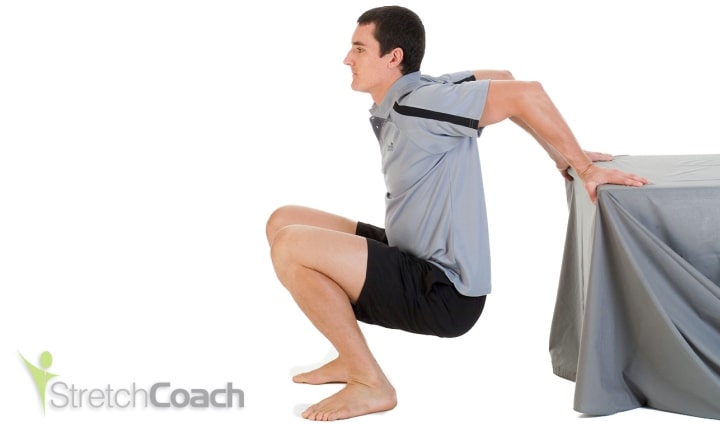
Below are 3 of the best stretches for squash; obviously there are a lot more, but these are a great place to start. Please make special note of the instructions with each stretch, and if you currently have any chronic or recurring muscle or joint pain please take extra care when performing the stretches below, or consult with your physician or physical therapist before performing any of the following stretches.
Instructions: Slowly move into the stretch position until you feel a tension of about 7 out of 10. If you feel pain or discomfort you’ve pushed the stretch too far; back out of the stretch immediately. Hold the stretch position for 20 to 30 seconds while relaxing and breathing deeply. Come out of the stretch carefully and perform the stretch on the opposite side if necessary. Repeat 2 or 3 times.


Research and References
- Walker, B. (2011). The Anatomy of Stretching, 2nd Edition (ISBN: 978-1583943717)
- Wikipedia contributors. (2019, March 25). Squash (sport), In Wikipedia, The Free Encyclopedia.
- Deakin University. (1998). Squash Fact Sheet. Sports Medicine Australia.
- Berson, B. Rolnick, A. Ramos, C. Thornton, J. (1981). An epidemiologic study of squash injuries. The American Journal of Sports Medicine, 9(2), 103-106.
- Meyer, L. Van Niekerk, L. Prinsloo, E. Steenkamp, M. Louw, Q. (2007). Prevalence of musculoskeletal injuries among adolescent squash players in the Western Cape. South African Journal of Sports Medicine, 19(1), 3-8.
- Gamble, P. (2013). Designing an Annual Training Plan for a Young Developing Squash Player: A Case Study. Journal of Australian Strength and Conditioning, 21(2): 63-70.
- Kokkonen, J. Nelson, A. Eldredge, C. Winchester, J. (2007) Chronic Static Stretching Improves Exercise Performance. Medicine & Science in Sports & Exercise, 39(10), 1825-1831.
- Shellock, F, Prentice, W. (1985) Warming-up and stretching for improved physical performance and prevention of sports-related injuries. Sports Medicine, 2(4):267-78.
- Fradkin, A. Zazryn, T. Smoliga, J. (2010) Effects of warming-up on physical performance: a systematic review with meta-analysis. Journal of Strength and Conditioning Research, 24(1):140-8.
 About the Author: Brad Walker is often referred to as the "Stretch Coach" and has even been called the Stretching Guru. Magazines such as Runners World, Bicycling, Triathlete, Swimming & Fitness, and Triathlon Sports have all featured his work. Amazon (author page) has listed his books on five Best-Seller lists. Google cites over 100,000 references to him and his work on the internet. And satisfied customers from 122 countries have sent 1,000's of verified customer reviews. If you want to know about stretching, flexibility or sports injury management, Brad Walker is the go-to-guy.
Disclaimer: The health and fitness information presented on this website is intended as an educational resource and is not intended as a substitute for proper medical advice. Please consult your physician or physical therapist before performing any of the exercises described on this website, particularly if you are pregnant, elderly or have any chronic or recurring muscle or joint pain.


