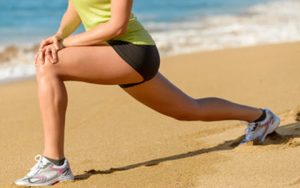
The 3 Best Stretches for Basketball
Improve your basketball and minimize injuries with 3 of the best basketball stretches.
by Brad Walker | Updated August 1, 2024
An appropriate mix of skill, stamina and strength is essential for the game of basketball. Incorporate regular stretches for basketball into your basketball training schedule to prepare your body for the physical demands of the game. Basketball training helps take your game to the next level.
Muscles used in Basketball
All the muscles in the body play an important role in a game of basketball. Running, jumping, and pivoting involve muscles throughout the trunk, legs and feet. The quadriceps and hamstring muscles play a crucial role in these activities, as well as the abdominals, calf and gluteus muscles.
Passing, throwing and shooting in basketball involves the upper body muscles, such as the rotator cuff muscles, coracobrachialis, latissimus dorsi, biceps brachii, brachioradialis and triceps brachii.

Most Common Basketball Injuries
Like many athletic injuries, those occurring in basketball may be classified as chronic (overuse) injuries or acute (traumatic) injuries.
Chronic injuries occur when a particular area is put under continual stress and becomes fatigued and damaged in the process, causing pain, loss of movement, and in many cases, swelling. Common chronic injuries in basketball include:
- Rotator cuff tendinitis;
- Patellar tendinitis, also known as jumper’s knee; and
- Achilles tendinitis.
Acute injuries, unlike chronic or overuse injuries, result from a sudden forceful event. Some of the most common acute injuries in basketball include:
- Muscle strains or tears
- Jammed fingers;
- Groin strain;
- Knee injuries, including anterior cruciate ligament (ACL) sprain and meniscus tear; and
- Ankle sprains.
Injury Prevention Strategies
Conditioning and technique training are all essential in basketball, and may help to avoid some of the more common injuries, particularly those due to overuse, as well as common muscle and tendon strains and tears. The following are also useful in helping to prevent basketball injuries.
- Warm-up properly prior to training and especially competition.
- Allow time for a complete cool-down period after training and competition.
- Strength training and improved cardiovascular fitness will help to build resistance to injury.
- Good flexibility training will reduce injuries from tight and inflexible muscles.
- Practicing balance, agility and proprioception drills to improve knee and ankle stability.
- Be aware of the position of other players on the court, to avoid collisions.
- Proper, snug-fitting and supportive footwear can help avoid injuries.
- Use of ankle supports (braces, taping, strapping, etc.) can reduce the incidence of ankle sprains.
- A mouth guard helps protect the teeth and mouth.
- Safety glasses should be used by those wearing eyeglasses.
- Basketball courts, whether indoors or out must be free of obstructions and debris.

The 3 Best Stretches for Basketball
Stretching is one of the most under-utilized techniques for improving athletic performance, preventing sports injury and properly rehabilitating sprain and strain injury. Don’t make the mistake of thinking that something as simple as stretching won’t be effective.
As with any sport or activity there are rules and guidelines to ensure that they are safe. Stretching is no exception. Stretching can be harmful and cause injury if done incorrectly. It is vitally important that the following stretching guidelines be adhered to, both for safety and for maximizing the benefits of the stretches below.
Below are 3 of the best stretches for basketball; obviously there are a lot more, but these are a great place to start. Please make special note of the instructions with each stretch, and if you currently have any chronic or recurring muscle or joint pain please take extra care when performing the stretches below, or consult with your physician or physical therapist before performing any of the following stretches.
Instructions: Slowly move into the stretch position until you feel a tension of about 7 out of 10. If you feel pain or discomfort you’ve pushed the stretch too far; back out of the stretch immediately. Hold the stretch position for 20 to 30 seconds while relaxing and breathing deeply. Come out of the stretch carefully and perform the stretch on the opposite side if necessary. Repeat 2 or 3 times.

Rotating Stomach and Side Stretch: Lie face down and bring your hands close to your shoulders. Keep your hips on the ground, look forward and rise up by straightening your arms. The slowly bend one arm and rotate that shoulder towards the ground.


Single Heel-drop Calf and Achilles Stretch: Stand on a raised object or step and place the ball of one foot on the edge of the step. Bend your knee slightly and let your heel drop towards the ground.
Watch the Basketball Stretches video
Click on the play button below if you prefer to follow along to a 10 minute video of the best stretches for basketball.
These stretches for basketball are best done after your basketball training, as part of your cool down. They can also be done as a stand-alone stretching session to improve your basketball flexibility, but make sure you’re fully warmed up before starting the stretches.
Research and References
- Walker, B. (2011). The Anatomy of Stretching, 2nd Edition (ISBN: 978-1583943717)
- Wikipedia contributors. (2019, April 24). Basketball, In Wikipedia, The Free Encyclopedia.
- Emery, C. Rose, M. McAllister, J. Meeuwisse, W. (2007). A prevention strategy to reduce the incidence of injury in high school basketball: a cluster randomized controlled trial. Clinical Journal of Sport Medicine, 17(1), 17-24.
- Lim, B. Lee, Y. Kim, J. An, K. Yoo, J. Kwon, Y. (2009). Effects of sports injury prevention training on the biomechanical risk factors of anterior cruciate ligament injury in high school female basketball players. The American Journal of Sports Medicine, 37(9), 1728-1734.
- McGuine, T. Brooks, A. Hetzel, S. (2011). The effect of lace-up ankle braces on injury rates in high school basketball players. The American Journal of Sports Medicine, 39(9), 1840-1848.
- Woolstenhulme, M. Griffiths, C. Woolstenhulme, E. Parcell, A. (2006). Ballistic stretching increases flexibility and acute vertical jump height when combined with basketball activity. The Journal of Strength & Conditioning Research, 20(4), 799-803.
- Kokkonen, J. Nelson, A. Eldredge, C. Winchester, J. (2007) Chronic Static Stretching Improves Exercise Performance. Medicine & Science in Sports & Exercise, 39(10), 1825-1831.
- Shellock, F, Prentice, W. (1985) Warming-up and stretching for improved physical performance and prevention of sports-related injuries. Sports Medicine, 2(4):267-78.
- Fradkin, A. Zazryn, T. Smoliga, J. (2010) Effects of warming-up on physical performance: a systematic review with meta-analysis. Journal of Strength and Conditioning Research, 24(1):140-8.
 About the Author: Brad Walker is often referred to as the "Stretch Coach" and has even been called the Stretching Guru. Magazines such as Runners World, Bicycling, Triathlete, Swimming & Fitness, and Triathlon Sports have all featured his work. Amazon (author page) has listed his books on five Best-Seller lists. Google cites over 100,000 references to him and his work on the internet. And satisfied customers from 122 countries have sent 1,000's of verified customer reviews. If you want to know about stretching, flexibility or sports injury management, Brad Walker is the go-to-guy.
Disclaimer: The health and fitness information presented on this website is intended as an educational resource and is not intended as a substitute for proper medical advice. Please consult your physician or physical therapist before performing any of the exercises described on this website, particularly if you are pregnant, elderly or have any chronic or recurring muscle or joint pain.