6 Best Sciatica Stretches and Exercises
Stretches for sciatica to improve your hip and buttocks flexibility and relieve tight sciatic nerve pain.
by Brad Walker | Updated July 31, 2024
Sciatica stretches are important for the flexibility and range of motion of the hip and buttocks muscles. Good flexibility around the sciatic nerve allows for unrestricted, pain free movement of the hip and buttocks, which is vital for reducing the incidents of sciatic nerve pain.
Activities that Benefit from Sciatica Stretches
Sports and activities that benefit from the sciatica stretches below include: Running, Walking, Hiking, Backpacking, Mountaineering, Orienteering, and Race Walking. Cycling, Ice Hockey, Ice Skating, Roller Skating, and Inline Skating. Snow Skiing, Water Skiing, and Surfing. Martial Arts, Wrestling, and any sport that involves jumping or explosive movement.
Running sports like Football, Soccer, Gridiron, Field Hockey, Basketball, and Rugby also benefit from regular sciatic nerve stretches.

Watch the Video for a Summary of This Article

Muscles that affect the Sciatic Nerve
While performing the sciatica stretches below there are a number of muscles within the hip and buttocks that are stretched. Below is a comprehensive list of the anatomical muscle names involved in the following sciatica stretches.
- Gluteus maximus, medius and minimus (Buttocks);
- Gemellus superior and inferior (Deep hip);
- Piriformis (Deep hip);
- Quadratus femoris (Deep hip); and
- Obturator internus and externus (Deep hip).
Safety Guidelines for Sciatica Stretches
As with all athletic activities there are precautions to ensure that they are safe; stretching is no exception. Stretching can be harmful if done incorrectly, so it is important that the following stretching guidelines be adhered to, both for safety and for maximizing the benefits of the stretches below.
- Always warm-up before performing any calf stretching exercises.
- Breathe. Don’t hold your breath. Holding your breath can lead to tension in the muscles and entire body. The deeper you breathe, the more relaxed you are, and the better you will be able to stretch.
- Never force a stretch beyond the point of mild discomfort. Stretching tight muscles will be uncomfortable, but you should never push to the point of pain. Move into the stretch until you feel a comfortable tension and hold the stretch there.
- Be consistent. Just like any physical activity, consistency is key. Stretching for a few minutes each day is preferable to stretching only once a week for a longer time.
- Wear loose comfortable clothing. It’s obviously very difficult to stretch if your clothes are tight and restrict movement.
Sample Sciatica Stretches
Slowly move into the stretch position until you feel a tension of about 7 out of 10. If you feel pain or discomfort you’ve pushed the stretch too far; back out of the stretch immediately. Hold the stretch position for 20 to 30 seconds while relaxing and breathing deeply. Come out of the stretch carefully and perform the stretch on the opposite side if necessary. Repeat 2 or 3 times.


Sample Sciatica Stretching Videos
Below you’ll find a few good stretches for the muscles around your sciatic nerve. But don’t rely on just a few stretches; it’s important to do a range of stretches for the hips, buttocks, groin and lower back. Please be careful, if you haven’t stretched these muscles before some of them may put a lot of stress on the sciatic nerve. Warm-up first, then proceed in a slow and gentle way.
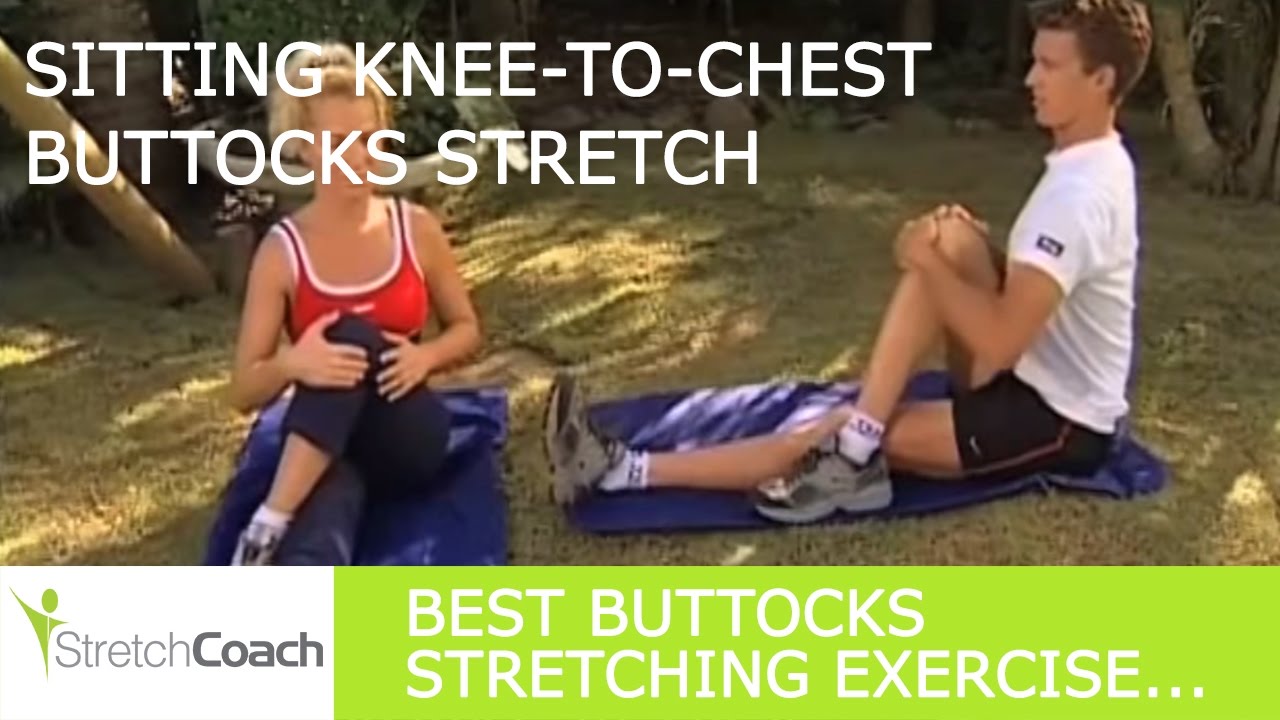
Sitting Knee-to-chest Sciatica Stretch (1:22) Sit with one leg straight and the other leg crossed over your knee. Pull the raised knee towards your opposite shoulder while keeping your back straight and your shoulders facing forward. Keeping your back straight and your shoulders facing forward will ensure that your buttocks get the maximum benefit from this stretch. Resist the temptation to rotate your shoulders towards your knee. Hold the stretch position for a minimum of 20 seconds and then repeat on the opposite side.

Sitting Foot-to-chest Sciatica Stretch (1:22) Sit with one leg straight and hold onto your other ankle. Pull it directly towards your chest. Use your hands and arms to regulate the intensity of this stretch. The closer you pull your foot to your chest, the more intense the stretch. Hold the stretch position for a minimum of 20 seconds and then repeat on the opposite side.

Sitting Cross-legged Sciatica Stretch (1:05) Sit cross legged and keep your back straight. Then gently lean forward. Make the emphasis of this stretch keeping your back straight, rather than trying to lean too far forward. Hold the stretch position for a minimum of 20 seconds.

Cross-over Sciatica Stretch (1:27) Lie on your back and cross one leg over the other. Bring your foot up to your opposite knee and with your opposite arm pull your raised knee towards the ground. Keep your shoulders on the ground and concentrate on pulling your raised knee to the ground, not up towards your chest. Hold the stretch position for a minimum of 20 seconds and then repeat on the opposite side.
Research and References
- Walker, B. (2011). The Anatomy of Stretching, 2nd Edition (ISBN: 978-1583943717)
- Wikipedia contributors. (2019, May 19). Sciatica, In Wikipedia, The Free Encyclopedia.
- Jones, O. (September 27, 2018). Muscles of the Gluteal Region. Retrieved May 16, 2019, from https://teachmeanatomy.info/lower-limb/muscles/gluteal-region/.
- Bertolini, G. Silva, T. Trindade, D. Ciena, A. Carvalho, A. (2009). Neural mobilization and static stretching in an experimental sciatica model: an experimental study. Brazilian Journal of Physical Therapy, 13(6), 493-498.
- Bell, J. (2008). Massage therapy helps to increase range of motion, decrease pain and assist in healing a client with low back pain and sciatica symptoms. Journal of Bodywork and Movement Therapies, 12(3) 281-289.
- Samanta, A. Beardsley, J. (1999). Sciatica: which intervention?. British Medical Journal, 319(7205): 302–303.
 About the Author: Brad Walker is often referred to as the "Stretch Coach" and has even been called the Stretching Guru. Magazines such as Runners World, Bicycling, Triathlete, Swimming & Fitness, and Triathlon Sports have all featured his work. Amazon (author page) has listed his books on five Best-Seller lists. Google cites over 100,000 references to him and his work on the internet. And satisfied customers from 122 countries have sent 1,000's of verified customer reviews. If you want to know about stretching, flexibility or sports injury management, Brad Walker is the go-to-guy.
Disclaimer: The health and fitness information presented on this website is intended as an educational resource and is not intended as a substitute for proper medical advice. Please consult your physician or physical therapist before performing any of the exercises described on this website, particularly if you are pregnant, elderly or have any chronic or recurring muscle or joint pain.