6 Best Glute and Piriformis Stretches and Exercises
Glute and Piriformis stretches to improve your piriformis flexibility and relieve tight buttocks and glute muscles.
by Brad Walker | Updated August 19, 2024
- Standing Leg-tuck Glute and Piriformis Stretch
- Lying Leg-resting Glute and Piriformis Stretch
- Sitting Knee-to-chest Glute and Buttocks Stretch
- Sitting Foot-to-chest Glute and Piriformis Stretch
- Sitting Cross-Legged Hip Stretch
- Cross-Over Glute Stretch
Glute and piriformis stretches are important for the flexibility and range of motion of the gluteus and deep buttocks muscles. Good glute and piriformis flexibility allows for unrestricted, pain free movement of the upper leg and buttocks. Adequate piriformis flexibility will also help to reduce the likelihood of piriformis syndrome.
Sports that Benefit from Glute and Piriformis Stretches
Sports that benefit from the piriformis and glute stretches below include: Running, track, cross country, cycling and any activity that involves walking (hiking, backpacking, mountaineering, orienteering and race walking). Any sport that involves explosive movement or quick changes of direction, like soccer, football, gridiron, rugby, basketball, netball, hockey and martial arts also benefit from regular glute and piriformis stretching.

Glute and Piriformis Muscles being Stretched
While performing the glute and piriformis stretches below there are a number of muscles within the buttocks that are stretched. Below is a comprehensive list of the anatomical muscle names involved in the following stretches.
- Gluteus Maximus, Medius and Minimus (Superficial Buttocks);
- Piriformis (Deep Buttocks);
- Gemellus Superior and inferior (Deep Buttocks);
- Obturator Internus (Deep Buttocks); and
- Quadratus Femoris (Deep Buttocks).
Glute and Piriformis Stretching Safety Guidelines
As with any physical activity there are rules and guidelines to ensure that they are safe. Glute and piriformis stretches are no exception. Stretching can be very dangerous and cause injury if done incorrectly. It is vitally important that the following stretching guidelines be adhered to, both for safety and for maximizing the benefits of stretches below.
- Always warm-up before performing any piriformis or glute stretching exercises.
- Breathe deeply. Don’t hold your breath. Holding your breath causes muscle tension and can raise your blood pressure. The deeper you breathe, the more relaxed your muscles will be, and the deeper and longer you will be able to stretch.
- Never push a stretch beyond the point of mild discomfort. Stretching tight muscles can be uncomfortable, but you should never feel any sharp or sudden pain. If you do, stop immediately; you are pushing the stretch too far.
- Be consistent. Stretching for a few minutes a couple of times a day will gradually build flexibility and range of motion. This is a better way to stretch, rather than only once a week for a longer time.
- Wear loose comfortable clothing. It’s obviously very difficult to stretch if your clothes are tight and restrict movement.
Sample Glute and Piriformis Stretches
Slowly move into the stretch position until you feel a tension of about 7 out of 10. If you feel pain or discomfort you’ve pushed the stretch too far; back out of the stretch immediately. Hold the stretch position for 20 to 30 seconds while relaxing and breathing deeply. Come out of the stretch carefully and perform the stretch on the opposite side if necessary. Repeat 2 or 3 times.
Please note: The piriformis muscle is located deep within the buttocks area and can be difficult to stretch if the muscles around it are tight. If you have difficulty performing any of the stretches below, start with some easy hamstring, quad and lower back stretches to loosen up the muscles around the piriformis first, and then come back to the stretches below.
Standing Leg-tuck Glute and Piriformis Stretch
Stand beside a chair or table and place the foot furthest from the object onto the object. Relax your leg, lean forward and bend your other leg, lowering yourself towards the ground. Hold this stretch for about 20 to 30 seconds and repeat at least 2 to 3 times on each side.

Lying Leg-resting Glute and Piriformis Stretch
Lie on your back and slightly bend one leg. Raise your other foot up onto your bent leg and rest it on your thigh. Then reach forward, holding onto your knee and pull towards you. As above, hold this stretch for about 20 to 30 seconds and repeat at least 2 to 3 times on each side.

Sample Glute and Piriformis Stretching Videos
Below you’ll find a few good glutes and piriformis stretches. But don’t rely on just a few stretches; it’s important to do a range of stretches for the buttocks, hamstrings, hips and groin. Please be careful, if you haven’t stretched your glutes and piriformis muscle, some of these stretches will put a lot of stress on the muscles and tendons. Warm-up first, then proceed in a gradual and gently way.
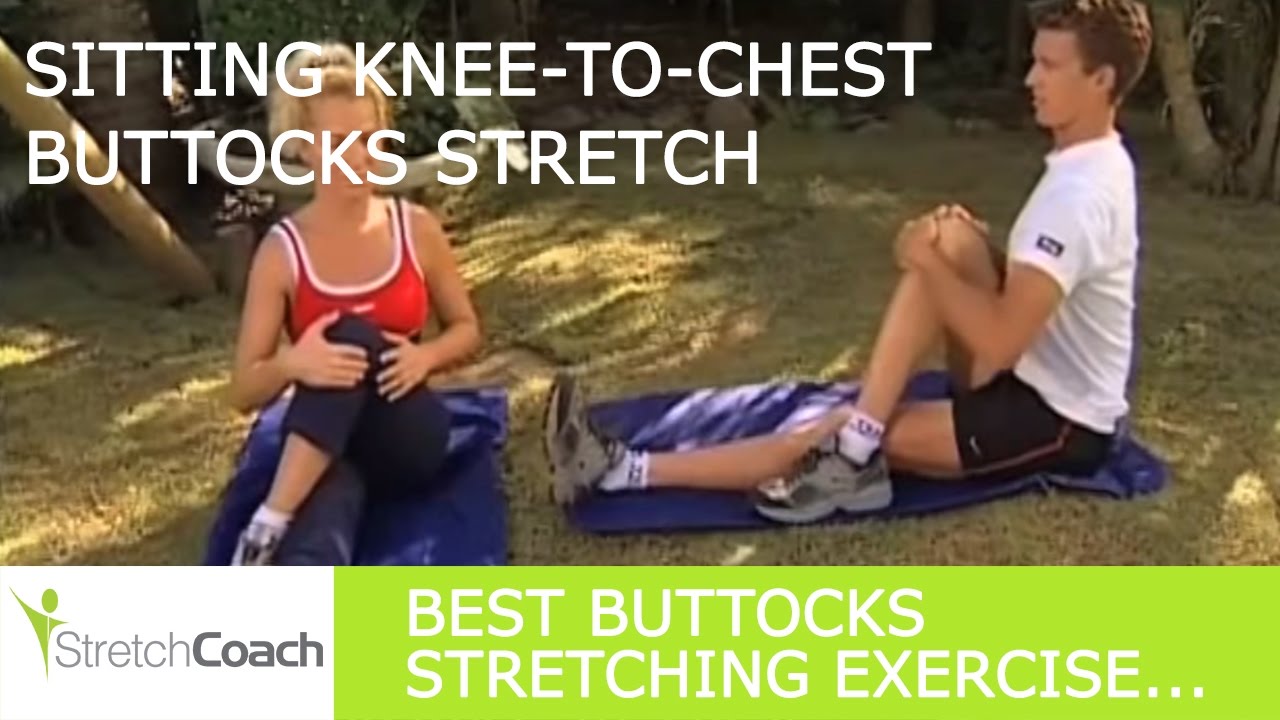
Sitting Knee-to-chest Glute and Buttocks Stretch
Sit with one leg straight and the other leg crossed over your knee. Pull the raised knee towards your opposite shoulder while keeping your back straight and your shoulders facing forward. Keeping your back straight and your shoulders facing forward will ensure that your buttocks get the maximum benefit from this stretch. Resist the temptation to rotate your shoulders towards your knee. Hold the stretch position for a minimum of 20 seconds and then repeat on the opposite side (1:22).
Sitting Foot-to-chest Glute and Piriformis Stretch
Sit with one leg straight and hold onto your other ankle. Pull it directly towards your chest. Use your hands and arms to regulate the intensity of this stretch. The closer you pull your foot to your chest, the more intense the stretch. Hold the stretch position for a minimum of 20 seconds and then repeat on the opposite side (1:22).

Sitting Cross-Legged Hip Stretch
Sit cross legged and keep your back straight. Then gently lean forward. Make the emphasis of this stretch keeping your back straight, rather than trying to lean too far forward. Hold the stretch position for a minimum of 20 seconds (1:05).

Cross-Over Glute Stretch
Lie on your back and cross one leg over the other. Bring your foot up to your opposite knee and with your opposite arm pull your raised knee towards the ground. Keep your shoulders on the ground and concentrate on pulling your raised knee to the ground, not up towards your chest. Hold the stretch position for a minimum of 20 seconds and then repeat on the opposite side (1:27).

Research and References
- Walker, B. (2011). The Anatomy of Stretching, 2nd Edition (ISBN: 978-1583943717)
- Wikipedia contributors. (2019, March 8). Piriformis muscle, In Wikipedia, The Free Encyclopedia.
- Jones, O. (September 27, 2018). Muscles of the Gluteal Region. Retrieved June 17, 2019, from https://teachmeanatomy.info/lower-limb/muscles/gluteal-region/.
- Mohanty, P. Pattnaik, M. (2017). Effect of stretching of piriformis and iliopsoas in coccydynia. Journal of Bodywork and Movement Therapies, 21(3), 743-746.
- Park, J. Shim, J. Chung, S. (2017). The effects of three types of piriform muscle stretching on muscle thickness and the medial rotation angle of the coxal articulation. Journal of Physical Therapy Science, 29(10):1811–1814.
- Gulledge, B. Marcellin-Little, D. Levine, D. Tillman, L. Harrysson, O. Osborne, J. Baxter, B. (2014). Comparison of two stretching methods and optimization of stretching protocol for the piriformis muscle. Medical Engineering and Physics, 36(2):212-8.
- Lim, J. Lee, I. Kim, D. (2018). A Movement-System-Impairment Approach to the Evaluation and Treatment of a Patient with Piriformis Syndrome: A Case Report. Journal of Musculoskeletal Science and Technology, 2(2):43-49.
- Awan, W. (2011). Effectiveness of Deep Friction Massage & Stretching Exercises in Piriformis Syndrome. Institute of Interdisciplinary Business Research, Vol 3,No 3.
 About the Author: Brad Walker is often referred to as the "Stretch Coach" and has even been called the Stretching Guru. Magazines such as Runners World, Bicycling, Triathlete, Swimming & Fitness, and Triathlon Sports have all featured his work. Amazon (author page) has listed his books on five Best-Seller lists. Google cites over 100,000 references to him and his work on the internet. And satisfied customers from 122 countries have sent 1,000's of verified customer reviews. If you want to know about stretching, flexibility or sports injury management, Brad Walker is the go-to-guy.
Disclaimer: The health and fitness information presented on this website is intended as an educational resource and is not intended as a substitute for proper medical advice. Please consult your physician or physical therapist before performing any of the exercises described on this website, particularly if you are pregnant, elderly or have any chronic or recurring muscle or joint pain.