6 Best Groin and Adductor Stretches and Exercises
Groin and Adductor stretches to improve your inner thigh flexibility and relieve tight adductor muscles.
by Brad Walker | Updated August 19, 2024
- Standing Wide-knees Adductor Stretch
- Standing Wide-leg Adductor Stretch
- Kneeling Face-down Adductor Stretch
- Sitting Wide-leg Adductor Stretch
- Sitting Feet-together Adductor Stretch
- Squatting Leg-out Adductor Stretch
Groin and adductor stretches are important for the flexibility and range of motion of the adductor muscles. Good groin and adductor flexibility allows for unrestricted, pain free movement of the inner thigh and upper leg. Adequate groin flexibility will also help to reduce the likelihood of groin strain injuries.
Sports that Benefit from Groin and Adductor Stretches
Sports that benefit from the groin and adductor stretches below include team sports like soccer, basketball, netball, lacrosse, rugby, football, gridiron and hockey. Plus, any sport that involves a lot of running or walking, such as, track, cross country hiking, backpacking, mountaineering, orienteering and race walking.
Sports that require rapid change of direction like tennis, squash, badminton and martial arts also benefit from regular groin and adductor stretching.

Groin and Adductor Muscles being Stretched
While performing the groin and adductor stretches below there are several muscles within the inner thigh and groin that are stretched. Below is a comprehensive list of the anatomical muscle names involved in the following stretches.
- Adductor Brevis (Inner thigh);
- Adductor Magnus (Inner thigh);
- Adductor Longus (Inner thigh);
- Gracilis (Inner thigh);
- Pectineus (Inner thigh);
Groin and Adductor Stretching Safety Guidelines
As with any sport or activity there are rules and guidelines to ensure that they are safe. Stretching is no exception. Stretching can be harmful and cause injury if done incorrectly. It is vitally important that the following guidelines be adhered to, both for safety and for maximizing the benefits of stretches below.
- Always warm-up before performing any groin stretching exercises.
- Breathe. Do not hold your breath. Holding your breath causes tension and stress in your muscle and can raise your blood pressure. The deeper you breathe, the more relaxed your muscles will be, and the deeper and longer you will be able to stretch.
- Never push a stretch beyond the point of mild discomfort. Stretching tight muscles can be uncomfortable, but you should never feel any sharp or stabbing pain. If you do, stop immediately; you are pushing the stretch too far.
- Be consistent. Stretching for a few minutes a couple of times a day will gradually build flexibility and range of motion over the long term. This is a better way to stretch, rather than stretching for a longer time only once a week.
- Wear loose comfortable clothing, as it’s difficult to stretch if your clothes are tight and restrict movement.
Sample Groin and Adductor Stretches
Slowly move into the stretch position until you feel a tension of about 7 out of 10. If you feel pain or discomfort, you’ve pushed the stretch too far; back out of the stretch immediately. Hold the stretch position for 20 to 30 seconds while relaxing and breathing deeply. Come out of the stretch carefully and perform the stretch on the opposite side if necessary. Repeat 2 or 3 times.
Standing Wide-knees Adductor Stretch
Stand with your feet wide apart and your toes pointing diagonally outwards, then bend your knees, lean forward and use your hands to push your knees outwards. Hold this stretch for about 20 to 30 seconds.

Standing Wide-leg Adductor Stretch
Start by standing with your feet wide apart and your toes pointing forward. Then lean forward and reach towards the ground. As above, hold this stretch for about 20 to 30 seconds.

Kneeling Face-down Adductor Stretch
Kneel face down with your knees and toes facing out. Lean forward and let your knees move outwards. As above, hold this stretch for about 20 to 30 seconds.

Sitting Wide-leg Adductor Stretch
Sit on the ground with your legs straight out and as wide apart as possible and then reach forward while keeping your back straight. As above, hold this stretch for about 20 to 30 seconds.

Sample Groin and Adductor Stretching Videos
Below you’ll find a few good stretches for your groin and inner thigh. But don’t rely on just a few stretches; it’s important to do a range of stretches for the buttocks, hamstrings, hips, quads and core. Please be careful, if you haven’t stretched your groin and adductor muscles, some of these stretches will put a lot of stress on the muscles and tendons. Warm-up first, then proceed in a gradual and gently way.
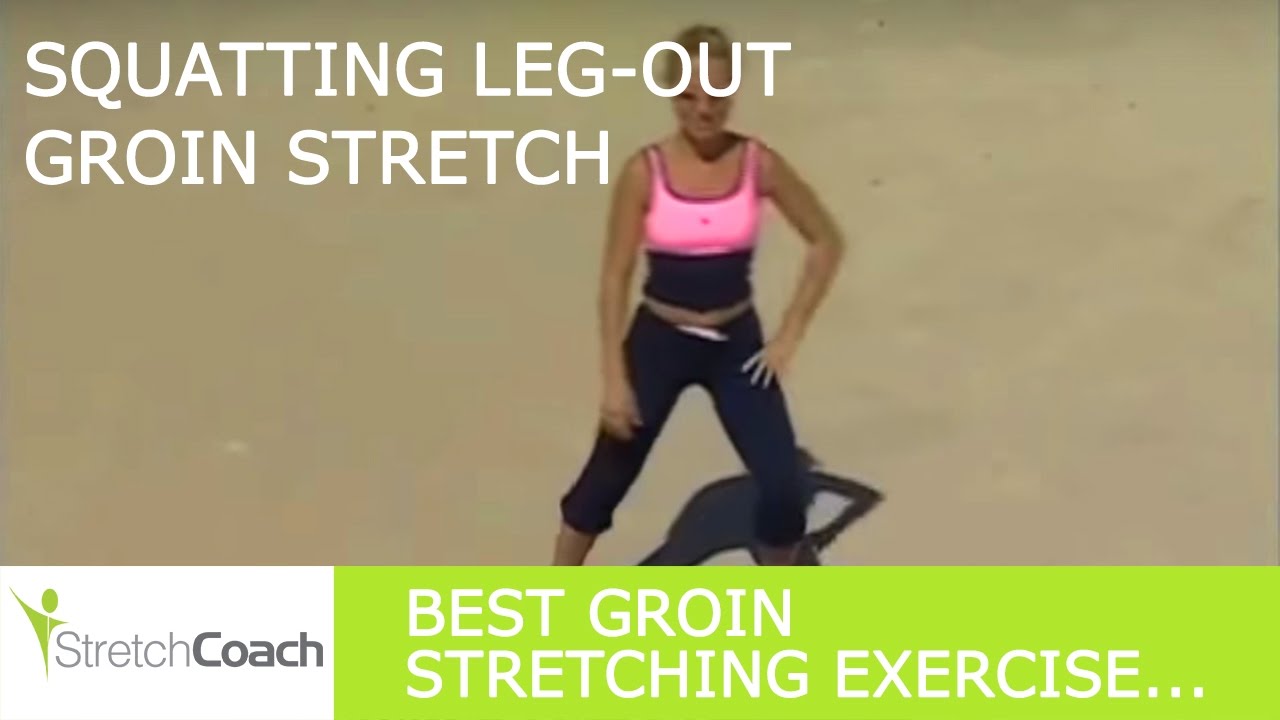
Squatting Leg-out Adductor Stretch
Stand with your feet wide apart. Keep one leg straight and your toes pointing forward while bending the other leg and turning your toes out to the side. Lower your groin towards the ground and rest your hands on your bent knee or the ground. Hold the stretch position for a minimum of 20 seconds and then repeat on the opposite side (1:21).
Sitting Feet-together Adductor Stretch
Sit with the soles of your feet together and bring your feet towards your groin. Hold onto your ankles and push your knees toward the ground with your elbows. Keep your back straight. Hold the stretch position for a minimum of 20 seconds (1:00).

Research and References
- Fjerstad, B. Hammer, R. Hammer, A. Connolly, G. Lomond, K. O’Connor, P. (2018). Comparison of Two Static Stretching Procedures on Hip Adductor Flexibility and Strength. International Journal of Exercise Science, 11(6): 1074–1085.
- Jones, O. (March 14, 2020). Muscles in the Medial Compartment of the Thigh. Retrieved June 30, 2021, from https://teachmeanatomy.info/lower-limb/muscles/thigh/medial-compartment/.
- Walker, B. (2011). The Anatomy of Stretching, 2nd Edition (ISBN: 978-1583943717)
- Wikipedia contributors. (2021, April 15). Groin, In Wikipedia, The Free Encyclopedia.
- Yousefzadeh, A. Shadmehr, A. Reza Olyaei, G. Naseri, N. Khazaeipour, Z. (2018). The Effect of Therapeutic Exercise on Long-Standing Adductor-Related Groin Pain in Athletes: Modified Hölmich Protocol. Rehabilitation Research and Practice, 2018: 8146819.
 About the Author: Brad Walker is often referred to as the "Stretch Coach" and has even been called the Stretching Guru. Magazines such as Runners World, Bicycling, Triathlete, Swimming & Fitness, and Triathlon Sports have all featured his work. Amazon (author page) has listed his books on five Best-Seller lists. Google cites over 100,000 references to him and his work on the internet. And satisfied customers from 122 countries have sent 1,000's of verified customer reviews. If you want to know about stretching, flexibility or sports injury management, Brad Walker is the go-to-guy.
Disclaimer: The health and fitness information presented on this website is intended as an educational resource and is not intended as a substitute for proper medical advice. Please consult your physician or physical therapist before performing any of the exercises described on this website, particularly if you are pregnant, elderly or have any chronic or recurring muscle or joint pain.