
What is Dynamic Stretching and Why is it Important for Your Workout Routine?
The pro’s, con’s and definitions. Including how to do a dynamic stretch, the 4 types of dynamic stretching and dynamic stretching examples.
by Brad Walker | Updated August 19, 2024
The term dynamic stretching (or dynamic stretches) refers to any stretch that is performed with movement.
In other words, the individual uses a swinging or bouncing movement to extend their range of motion (ROM) and flexibility. The force of the bounce or swing is gradually increased but should never become radical or uncontrolled.

4 Types of Dynamic Stretching
Listed below are four different types of dynamic stretches.
1. Ballistic Stretching
Ballistic stretching is an outdated form of stretching that uses momentum generated by rapid swinging, bouncing and rebounding movements to force a body part past its normal range of movement. The risks associated with ballistic stretching far outweigh the gains, especially when better gains can be achieved by using other forms of stretching. Other than potential injury, the main disadvantage of ballistic stretching is that it fails to allow the stretched muscle time to adapt to the stretched position and instead may cause the muscles to tighten up by repeatedly triggering the stretch reflex (or myotatic reflex).
2. Dynamic Stretching
Unlike ballistic stretching, dynamic stretching uses a controlled, soft bounce or swinging motion to move a particular body part to the limit of its range of movement. The force of the bounce or swing is gradually increased but should never become radical or uncontrolled. Do not confuse dynamic stretching with ballistic stretching. Dynamic stretching is slow, gentle and very purposeful. At no time during dynamic stretching should a body part be forced past the joints normal range of movement. Ballistic stretching, on the other hand, is much more aggressive and its very purpose is to force the body part beyond the limit of its normal range of movement.
3. Active Isolated (AI) Stretching
Active isolated (AI) stretching is a new form of stretching developed by Aaron L. Mattes. AI stretching is sometimes referred to as the Mattes Method. It works by contracting the antagonist, or opposing muscle group, which forces the stretched muscle group to relax. While AI stretching certainly has some benefits (mainly for the professional or well conditioned athlete), it also has a lot of unsubstantiated claims. One such claim is that AI stretching does not engage the stretch reflex because the stretch is only held for 2 seconds or less. This is nonsense and defies basic muscle physiology. The stretch reflex in the calf muscle for example is triggered within 3 hundredths of a second, so any claim that AI stretching can somehow bypass or outsmart the stretch reflex is nothing more than fantasy.
4. Resistance Stretching and Loaded Stretching
Resistance stretching and loaded stretching are a form of dynamic stretching that both contract and lengthen a muscle at the same time. They work by stretching a muscle group through its entire range of motion while under contraction. For this reason, both resistance stretching and loaded stretching are as much about strengthening a muscle group as they are about stretching it. Like AI stretching above, resistance stretching and loaded stretching do have their benefits. Five time Olympic swimmer, Dara Torres credits a portion of her swimming success to the use of resistance stretching. However, these forms of stretching place high demands on the musculo-skeletal system and are therefore only recommended for professional or well conditioned athletes.
What is Dynamic Flexibility?
The term dynamic flexibility refers to an individual’s absolute range of motion that can be achieved with movement. In other words, how far you can reach, bend or turn by using velocity and momentum to achieve maximum range of motion. Dynamic flexibility is sometimes referred to as ballistic or functional flexibility.
A similar definition comes from Corbin and Noble in the Journal of Physical Education and Recreation; they describe dynamic flexibility as…
“The ability to use a range of joint movement in the performance of a physical activity at either normal or rapid speed.”
As all sport involves movement of some kind, a degree of dynamic flexibility is essential; even more so for sports that require rapid or explosive sprinting, jumping and throwing.
How is Dynamic Stretching Different from Static Stretching?
Although there are many different ways to stretch, they can all be grouped into one of two categories; static or dynamic.
The main difference between dynamic stretching and static stretching is that static stretches are performed without movement. In other words, the individual gets into the stretch position and holds the stretch for a specific amount of time. While dynamic stretches are performed with movement.
Is Dynamic Stretching Dangerous?
Just like any other form of exercise, dynamic stretching can be dangerous if used incorrectly. One of the main dangers or disadvantages of dynamic stretching is that it is very easy to over-do-it, or push the stretches too hard or too fast.
A Word of Warning! If you’ve never done any dynamic stretching before make sure you start off very gently and slowly. Be sure to give yourself at least 2 or 3 sessions of easy dynamic stretches (with adequate rest in between) before trying to push or extend your flexibility with more energetic or rapid dynamic stretches.
Dynamic Stretching Examples
Take a look at the videos below for some examples of dynamic stretches that have been incorporated into a full body warm-up routine.
Please remember the warning above. The individuals in the videos below are well-conditioned athletes with prior training in dynamic stretching. If you have not done any dynamic stretching before, do not try to imitate the intensity of the stretches displayed in the video.

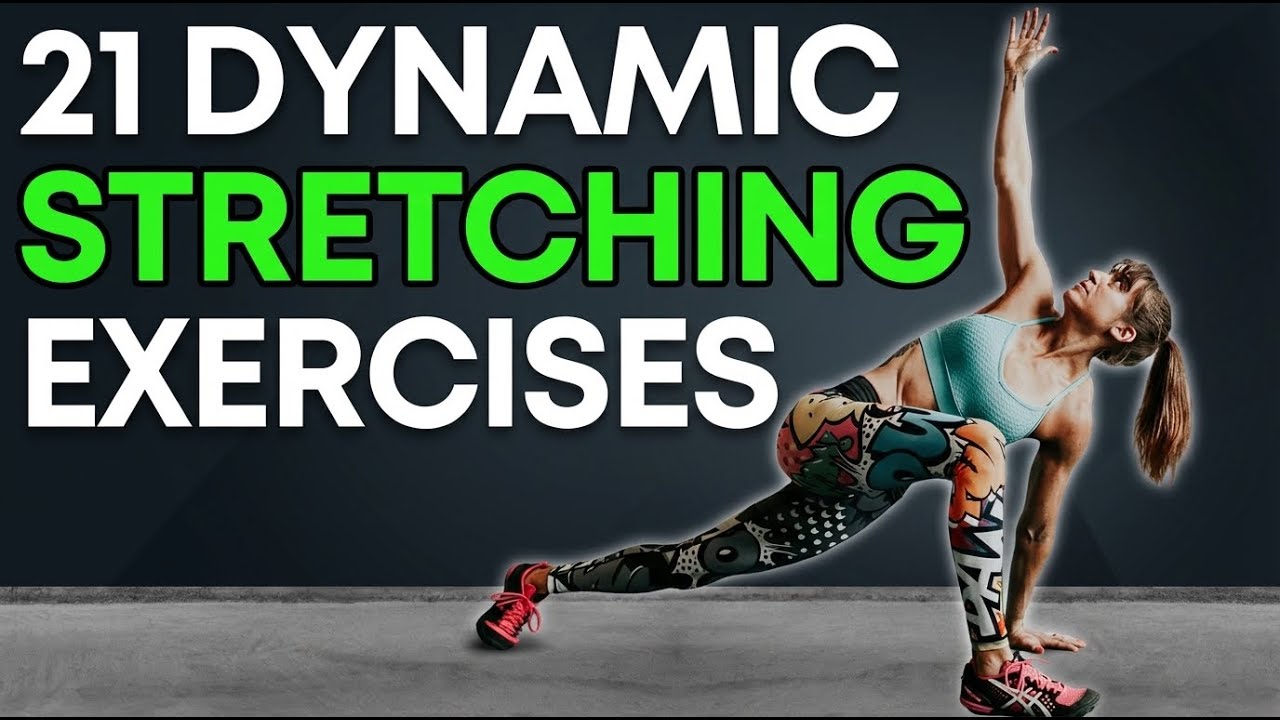
Many different ways to stretch
Just as there are many different ways to strength train, there are also many different ways to perform a stretch. However, it is important to note that although there are many different ways to stretch, no one way, or no one type of stretching is better than another. Each type has its own advantages and disadvantages, and the key to getting the most out of stretching lies in being able to match the right type of stretching to the purpose, or goal you are trying to achieve.
For example; For warming up, dynamic stretching is the most effective, while for cooling down, static and passive are best. For improving range of motion, try a combination of long-hold static stretching and PNF stretching, and for injury rehabilitation, Active Isolated stretching, PNF, Isometric and Active stretching will give the best results.

Best Time to use Dynamic Stretching
One of the main purposes of dynamic stretching is to prepare the body for activity or sport, which is why dynamic stretching is so effective as part of a warm-up routine.
Please note though, that dynamic stretching is not THE warm-up, is it only PART OF a warm-up. A proper warm-up has a number of very important key elements. These elements, or parts, should all work together to prepare the individual for physical activity and minimize the likelihood of sports injury.
Confusion about Dynamic Stretching
Dynamic stretching has received a lot of attention lately, and rightfully so. It’s a great form of stretching that is essential for many sports that require high levels of explosive power and speed.
Recently, some coaches, trainers and authors have made the claim that dynamic stretching has replaced static stretching and that… “Dynamic stretching is the revolutionary new warm-up method.”
It’s very important to remember that just as there are many different ways to strength train, there are also many different ways to stretch. However, although there are many different ways to stretch, no one way, or no one type of stretching is better than another.
Each type of stretching has its own advantages and disadvantages, and the key to getting the most out of stretching lies in being able to match the right type of stretching to the purpose or goal you are trying to achieve.
Dynamic stretching is not better than static stretching (and vice-versa; static stretching is not better than dynamic stretching), they are simply different; each with their own advantages and disadvantages.

Research and References
- Alter, M. (2004) Science of Flexibility, 3rd Edition (ISBN: 978-0736048989)
- Jeffrey J. Dalleck, L. Reyment, C. (2007). Pre-exercise Stretching and Performance. Research offers insight into flexibility, function and the pros and cons of stretching prior to activity. IDEA Fitness Journal, 4.2: 44(8).
- Kovacs, M. (2010) Dynamic Stretching, 1st Edition (ISBN: 978-1569757260)
- Lucas, R. Koslow, R. (1984) Comparative Study of Static, Dynamic, and Proprioceptive Neuromuscular Facilitation Stretching Techniques on Flexibility. Perceptual and Motor Skills, Volume: 58 issue: 2, page(s): 615-618.
- Opplert, J. Babault, N. (2018). Acute Effects of Dynamic Stretching on Muscle Flexibility and Performance: An Analysis of the Current Literature. Sports Medicine, 48(2):299-325.
- Page, P. (2012) Current Concepts in Muscle Stretching for Exercise and Rehabilitation. International Journal of Sports Physical Therapy, 7(1): 109–119.
- Walker, B. (2011). The Anatomy of Stretching, 2nd Edition (ISBN: 978-1583943717)
- Wikipedia contributors. (2019, June 25). Stretching, In Wikipedia, The Free Encyclopedia.
 About the Author: Brad Walker is often referred to as the "Stretch Coach" and has even been called the Stretching Guru. Magazines such as Runners World, Bicycling, Triathlete, Swimming & Fitness, and Triathlon Sports have all featured his work. Amazon (author page) has listed his books on five Best-Seller lists. Google cites over 100,000 references to him and his work on the internet. And satisfied customers from 122 countries have sent 1,000's of verified customer reviews. If you want to know about stretching, flexibility or sports injury management, Brad Walker is the go-to-guy.
Disclaimer: The health and fitness information presented on this website is intended as an educational resource and is not intended as a substitute for proper medical advice. Please consult your physician or physical therapist before performing any of the exercises described on this website, particularly if you are pregnant, elderly or have any chronic or recurring muscle or joint pain.


