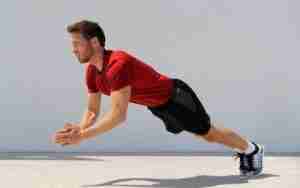
What is cross training and how can it prevent sports Injury?
Learn how to use cross training to prevent sports injury. Includes cross training exercises and examples.
by Brad Walker | Updated January 10, 2024
Cross training is a great form of exercise or training for athletic preparation and injury prevention.
Although it has been used for years, it is relatively new as a training concept. Athletes are often forced to use exercises or activities outside of their chosen sport for many reasons, including: weather and seasonal changes; facility and equipment availability; alternative conditioning; and for training while injured.

What is Cross Training?
Cross training is the use of various activities to achieve overall conditioning. Cross training uses activities outside the normal drills and exercises commonly associated with a sport. The exercises provide a break from the normal impact of training in a particular sport, thereby giving the muscles, tendons, bones, joints and ligaments a brief break. These exercises target the muscles from a different angle or resistance and work to balance an athlete. Cross training is an effective way of resting the body from the normal sport-specific activities while maintaining conditioning.
Any exercise or activity can be used for cross training if it is not a skill associated with that particular sport. Weight training is a commonly used cross training tool. Swimming, cycling, running, and even skiing are activities used for cross training. Circuit training and plyometrics are becoming popular again as cross training tools.
How does Cross Training prevent injury?
Variety in your exercise program is one of the most important factors for preventing injury. If you don’t include variety, 2 things can happen:
- You’ll develop strength and flexibility imbalances, which put uneven stresses on your muscles and joints, and can lead to injury.
- Every time you’re forced to do something that you’re not used to doing, you’re making your body use its muscles in a way it never has, which puts you at risk of injury.
Cross training is an important tool in the injury prevention program of athletes. Cross training allows coaches and athletes the opportunity to train hard all year round without running the risk of overtraining or overuse injuries. The simple process of changing the type of training changes the stress on the body.
- Cross training gives the muscles used in the primary sport a break from the normal stresses put on them each day. The muscles may still be worked, even intensely, but without the normal impact, or from a different angle. This allows the muscles to recover from the wear and tear built up over a season. This active rest is a much better recovery tool than total rest and forces the body to adapt to different stimuli.
- Cross training also helps to reduce or reverse muscle imbalances in the body. A pitcher in baseball may develop an imbalance laterally between the two sides of the body as well as in the shoulder girdle of the throwing arm. Thousands of pitches over a season will cause the muscles directly involved in throwing to become stronger while supporting muscles and those unaffected by throwing will become weaker. Cross training can help balance the strength in the muscles on both sides as well as the stabilizing muscles. This balancing of strength and flexibility helps to prevent one muscle group, due to a strength imbalance, pulling the body out of natural alignment. It also prevents muscle pulls and tears caused by one muscle exerting more force than the opposing group can counter.
The Downside of Cross Training
Cross training does help achieve balance in the muscles due to working them from various angles and in different positions. However, cross training does not develop skills specific to the sport or sport-specific conditioning. A football player who jogs three to five miles all summer and lifts weights will still not be in football shape when the preseason starts. Cross training cannot be used as the sole conditioning tool. Sport specific conditioning and skill training is still required.
High impact sports such as basketball, gymnastics, football or running cause a lot of jarring on the skeletal system. Cross training can help limit the jarring but some sport-specific impact is necessary to condition athletes for their activity. A runner who runs in water as their only conditioning routine may develop shin splints and other injuries when they are required to run on hard surfaces for races or training. Their body is not conditioned to the forces it is subjected to and will react accordingly.
An intense cross training schedule, without progressing into it gradually, can also lead to problems. It is important to progressively increase the intensity, duration and frequency in small increments.
Cross Training Precautions
Cross training is a smart addition to any exercise program, however, the most common problem associated with cross training is that people tend to get over excited, because the activity is different and new, and push themselves harder than they normally would. This tends to result in sore muscles and joints, and an increased likelihood of injury. Below are a few precautions you need to take into consideration.
- If you’ve never done any sort of cross training before, even if you consider yourself quite fit, start off slowly. Cross training will place different demand on the body and mind, and if you’re not used to it, it will take a few sessions for your body to adapt to this new form of training. Be patient.
- You’re warm-up and cool-down are crucial. DO NOT start any cross training workout without a thorough warm-up that includes stretching. As mentioned before, cross training is different from your usual forms of exercise, so prepare yourself properly.
- Proper Technique: Whenever starting a new activity it is important to get instruction in the proper techniques and safety measures. Ocean kayaking can be a great cross training activity for tennis players to develop and maintain upper body endurance but without instruction on proper techniques it can be dangerous.
- Equipment: Equipment used for cross training activities should be fitted properly and designed for the activity. Unsafe or ill-fitted equipment can lead to injury.
- Overtraining: Cross training is a great way to avoid overuse injuries and overtraining. Unfortunately, these same pitfalls can be an issue in a cross training program. Varying workouts, adequate rest between workouts, use of proper form and gradual increasing of resistance are important in any program. Many athletes simply add cross training to their current program rather than substituting, which can lead to overtraining and the opposite of the injury prevention goal.
- Stretching and Flexibility: Cross training, as with any new activity, places new and different demands on the body, so don’t forget to incorporate regular stretching and flexibility training into your cross training routines.
Cross Training Examples
Cross training can take many forms. The key to a successful cross training program is that it must address the same energy systems used in the sport, while allowing a break from sport specific activities. Training the same major muscle groups, but in a different way keeps the athlete conditioned but helps prevent overuse injuries.
- A cyclist may use swimming to build upper body strength and to maintain cardiovascular endurance. They may use cross-country skiing to maintain leg strength and endurance when snow and ice prevent biking time.
- Swimmers may use free weight training to develop and maintain strength levels. They may incorporate rock climbing to keep upper body strength and endurance up.
- Runners may use mountain biking to target the leg muscles from different angles. They can use deep water running to lessen the impact while still maintaining a conditioning schedule.
- A shot putter may use Olympic weightlifting exercises to build overall explosiveness. They may use plyometrics and sprinting to develop the needed explosiveness in the hips and legs.
Research and References
- Beachle, T. Earle, R. (2008). Essentials of Strength Training and Conditioning, 3rd Edition (ISBN: 978-0736058032)
- Burke, E. (1994). The Wisdom of Cross Training. Strength and Conditioning Journal, 16 (1) 58-60.
- Foster, C. Hector, L. Welsh, R. Schrager, M. Green, M. Snyder, A. (1995). Effects of specific versus cross-training on running performance. European Journal of Applied Physiology and Occupational Physiology, 70(4):367-72.
- Klein, I. White, J. Rana, S. (2016). Comparison of Physiological Variables Between the Elliptical Bicycle and Run Training in Experienced Runners. Journal of Strength Conditioning Research, 30(11):2998-3006.
- Paquette, M. Peel, S. Smith, R. Temme, M. Dwyer, J. (2018). The Impact of Different Cross-Training Modalities on Performance and Injury-Related Variables in High School Cross Country Runners. The Journal of Strength & Conditioning Research, 32(6) 1745-1753.
- Shepherd, J. Cross training: time invested or time wasted?. Retrieved September 14, 2022, from https://www.sportsperformancebulletin.com/endurance-training/cross-training-time-invested-time-wasted/.
- Tanaka, H. (1994). Effects of cross-training. Transfer of training effects on VO2max between cycling, running and swimming. Sports Medicine, 18(5):330-9.
- White, L. Dressendorfer, R. Muller, S. Ferguson, M. (2003). Effectiveness of cycle cross-training between competitive seasons in female distance runners. Journal of Strength Conditioning Research, 17(2):319-23.
- Wikipedia contributors. (2019, November 2). Cross-training, In Wikipedia, The Free Encyclopedia.
 About the Author: Brad Walker is often referred to as the "Stretch Coach" and has even been called the Stretching Guru. Magazines such as Runners World, Bicycling, Triathlete, Swimming & Fitness, and Triathlon Sports have all featured his work. Amazon (author page) has listed his books on five Best-Seller lists. Google cites over 100,000 references to him and his work on the internet. And satisfied customers from 122 countries have sent 1,000's of verified customer reviews. If you want to know about stretching, flexibility or sports injury management, Brad Walker is the go-to-guy.
Disclaimer: The health and fitness information presented on this website is intended as an educational resource and is not intended as a substitute for proper medical advice. Please consult your physician or physical therapist before performing any of the exercises described on this website, particularly if you are pregnant, elderly or have any chronic or recurring muscle or joint pain.