The 3 Best Stretches for Cricket
Improve your cricket and minimize injuries with 3 of the best cricket stretches.
by Brad Walker | Updated August 1, 2024
The origins of cricket date back to the late 16th century. It was invented in England and developed globally in the 19th and 20th centuries. Cricket is the world’s second most popular spectator sport after association football (soccer).
Like any sport, cricket requires a proper strength, conditioning and stretching program. By diligently following a series of cricket stretches, players can improve their sporting ability and avoid the various injuries associated with the game.

Muscles used in Cricket
Batting, bowling and fielding are the three main activities in cricket. Depending on the activity, different upper and lower body structures are involved. Since a lot of running is involved for all cricket players, significant focus on the hamstring, quadriceps and calf muscles must be included in cricket training.
- In batting, the upper limb structures, such as the shoulders and chest muscles play a significant role. The hips, buttocks, lower back and core muscles are also very important for generating power to hit the ball.
- Bowling places a great deal of stress on the core muscles; particularly the lower back muscles and hips. Bowling also relies heavily on the rotator cuff muscles of the shoulder.
- For players taking care of the field, cricket stretches should particularly focus on the muscles needed for throwing. These include the pectoral muscles, the rotator cuff muscles of the shoulder, and the forearm muscles.
Most Common Cricket Injuries
Cricket injuries may be either acute or chronic, the latter resulting from overuse, and the three elements that make up the game of cricket, (batting, bowling and fielding), each carry associated risk of injury. The repetitive nature of the game combined with long periods of play on the field produce a wide range of injuries, which may involve nearly any part of the body. Common cricket injuries include:
- Muscle bruises or contusions;
- Ankle sprain;
- Meniscus tear;
- Groin strain;
- Lower back pain;
- Throwers elbow;
- Ulnar collateral ligament (UCL) sprain; and
- Rotator cuff tendinitis and tears.
Injury Prevention Strategies
Comprehensive conditioning and technique training are all essential in cricket, and may help to avoid some of the more common injuries, particularly those due to overuse, as well as strains and tears of muscle or tendon. Additionally, the following steps should be taken to protect cricket players from common injuries:
- Always warm-up properly prior to training and especially competition.
- Allow an adequate cool down period after training and competition.
- Strength training and improved cardiovascular fitness will help to build resistance to injury.
- Good flexibility training will reduce injuries from tight and inflexible muscles.
- Attention to proper throwing and batting technique and form will help to reduce both overuse and acute injuries.
- Attention to field conditions is critical. Wet, uneven or obstructed playing surfaces pose considerable risk of injury.
- As summer athletes, cricket player are at risk for heat related injuries including dehydration, heat exhaustion, heat stroke and skin cancer. Players should maintain proper hydration and use sunscreen to protect the skin from damaging ultraviolet rays.
- In-fielders and batsmen should always wear properly-fitting pads and helmets (including visor). Such protection is critical to prevent injuries to the eyes or face.
- Proper footwear helps protect the feet from injury, should they be struck by the ball.
The 3 Best Stretches for Cricket
Stretching is one of the most under-utilized techniques for improving athletic performance, preventing sports injury and properly rehabilitating sprain and strain injury. Don’t make the mistake of thinking that something as simple as stretching won’t be effective.
As with any sport or activity there are rules and guidelines to ensure that they are safe. Stretching is no exception. Stretching can be harmful and cause injury if done incorrectly. It is vitally important that the following stretching guidelines be adhered to, both for safety and for maximizing the benefits of the stretches below.
Below are 3 of the best stretches for cricket; obviously there are a lot more, but these are a great place to start. Please make special note of the instructions with each stretch, and if you currently have any chronic or recurring muscle or joint pain please take extra care when performing the stretches below, or consult with your physician or physical therapist before performing any of the following stretches.
Instructions: Slowly move into the stretch position until you feel a tension of about 7 out of 10. If you feel pain or discomfort you’ve pushed the stretch too far; back out of the stretch immediately. Hold the stretch position for 20 to 30 seconds while relaxing and breathing deeply. Come out of the stretch carefully and perform the stretch on the opposite side if necessary. Repeat 2 or 3 times.

Standing High-leg Bent Knee Hamstring Stretch: Stand with one foot raised onto a table. Keep your leg bent and lean your chest into your bent knee.

Lying Knee Roll-over Stretch: While lying on your back, bend your knees and let them fall to one side. Keep your arms out to the side and let your back and hips rotate with your knees.

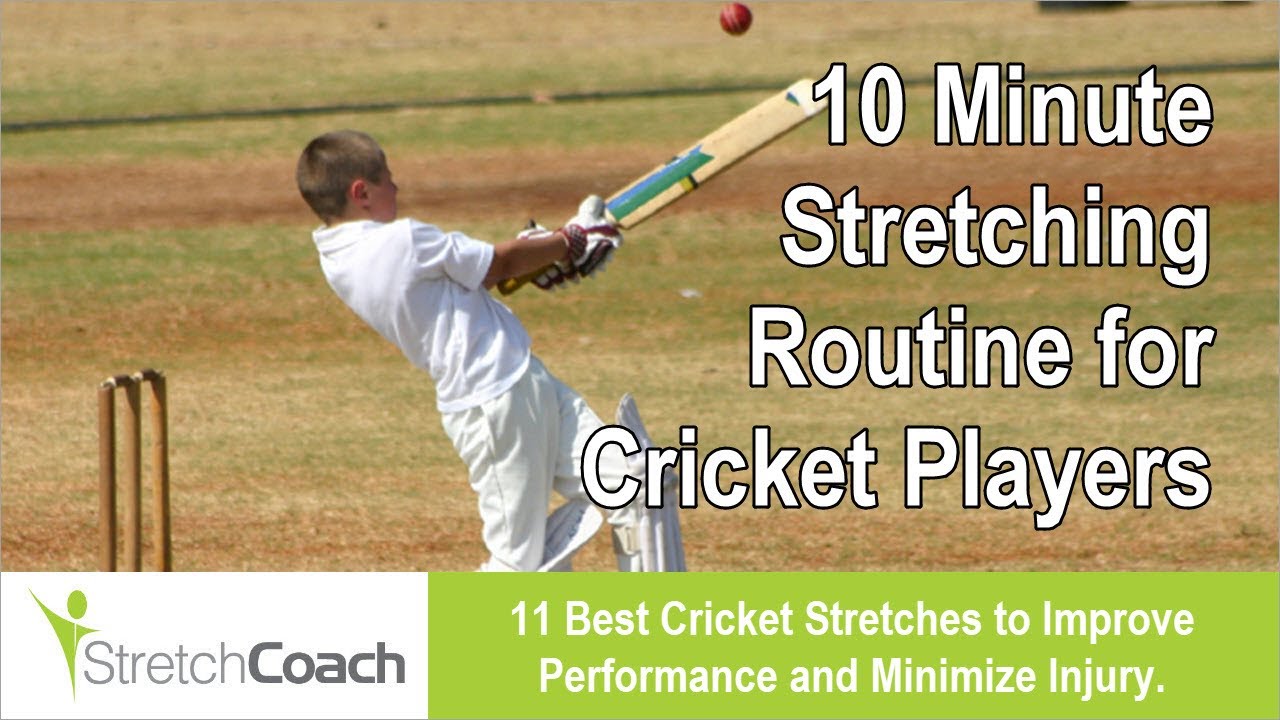
Watch the Cricket Stretches video
Click on the play button below if you prefer to follow along to a 10 minute video of the best stretches for cricket.
These cricket stretches are best done after your cricket training, as part of your cool down. They can also be done as a stand-alone stretching session to improve your cricket flexibility, but make sure you’re fully warmed up before starting the stretches.
Research and References
- Walker, B. (2011). The Anatomy of Stretching, 2nd Edition (ISBN: 978-1583943717)
- Wikipedia contributors. (2019, April 18). Cricket, In Wikipedia, The Free Encyclopedia.
- Pandey, C. (2015). Cricket injury epidemiology, mechanisms, and prevention. Sports Injuries: Prevention, Diagnosis, Treatment and Rehabilitation, 2729-2738.
- Finch, C. Elliott, B. McGrath, A. (1999). Measures to prevent cricket injuries. Sports Medicine, 28(4), 263-272.
- Stretch, R. Raffan, R. (2011). Injury patterns of South African international cricket players over a two-season period. South African Journal of Sports Medicine, 23(2), 45-49.
- Kokkonen, J. Nelson, A. Eldredge, C. Winchester, J. (2007) Chronic Static Stretching Improves Exercise Performance. Medicine & Science in Sports & Exercise, 39(10), 1825-1831.
- Shellock, F, Prentice, W. (1985) Warming-up and stretching for improved physical performance and prevention of sports-related injuries. Sports Medicine, 2(4):267-78.
- Fradkin, A. Zazryn, T. Smoliga, J. (2010) Effects of warming-up on physical performance: a systematic review with meta-analysis. Journal of Strength and Conditioning Research, 24(1):140-8.
 About the Author: Brad Walker is often referred to as the "Stretch Coach" and has even been called the Stretching Guru. Magazines such as Runners World, Bicycling, Triathlete, Swimming & Fitness, and Triathlon Sports have all featured his work. Amazon (author page) has listed his books on five Best-Seller lists. Google cites over 100,000 references to him and his work on the internet. And satisfied customers from 122 countries have sent 1,000's of verified customer reviews. If you want to know about stretching, flexibility or sports injury management, Brad Walker is the go-to-guy.
Disclaimer: The health and fitness information presented on this website is intended as an educational resource and is not intended as a substitute for proper medical advice. Please consult your physician or physical therapist before performing any of the exercises described on this website, particularly if you are pregnant, elderly or have any chronic or recurring muscle or joint pain.